There’s a reason biophilic design refuses to go out of style – humans are wired to respond to natural forms, even indoors. But bringing nature into a home doesn’t always mean potted plants and reclaimed wood tables. Increasingly, it means something more deliberate: marquetry design, the centuries-old art of inlaying wood veneers to create images and patterns, reimagined for contemporary interiors.
At Flava, we see marquetry not as decoration but as narrative. Every panel tells a story of the natural world, translated into grain, contrast, and craftsmanship. Here’s how this ancient technique is quietly transforming modern spaces.
What Makes Marquetry Different From Ordinary Veneer Work
Standard veneer covers a surface. Marquetry composes one.
The technique involves cutting and piecing together different wood veneers – varying in species, grain direction, and tone – to form a single cohesive image. Where inlay work traditionally used borders and geometric motifs, contemporary marquetry design pushes further, rendering entire scenes: birds in flight, tangled root systems, flowing water, dense foliage.
The result feels less like furniture with a pattern on it and more like a piece of art that happens to also be a cabinet, a wall panel, or a headboard.
Why Nature-Inspired Furniture Is Having a Moment
A few things are converging at once:
Fatigue with minimalism. After a decade of flat, monochrome, “quiet luxury” interiors, designers are craving texture and story again – without abandoning sophistication.
Demand for statement pieces. In an era where most furniture is mass-produced, a hand-composed marquetry piece signals intent. It can’t be replicated at scale, which is precisely its appeal.
A genuine desire to feel grounded. Nature-inspired furniture does something practical spreadsheets can’t quantify: it softens a space psychologically. Organic lines and living motifs make rooms feel calmer, even in high-density urban homes.
This is the exact tension our Wings of Eden collection was designed to resolve – the discipline of fine woodworking married to the wildness of the natural world.
Case Study: Wings of Eden – Marquetry as Immersive Art
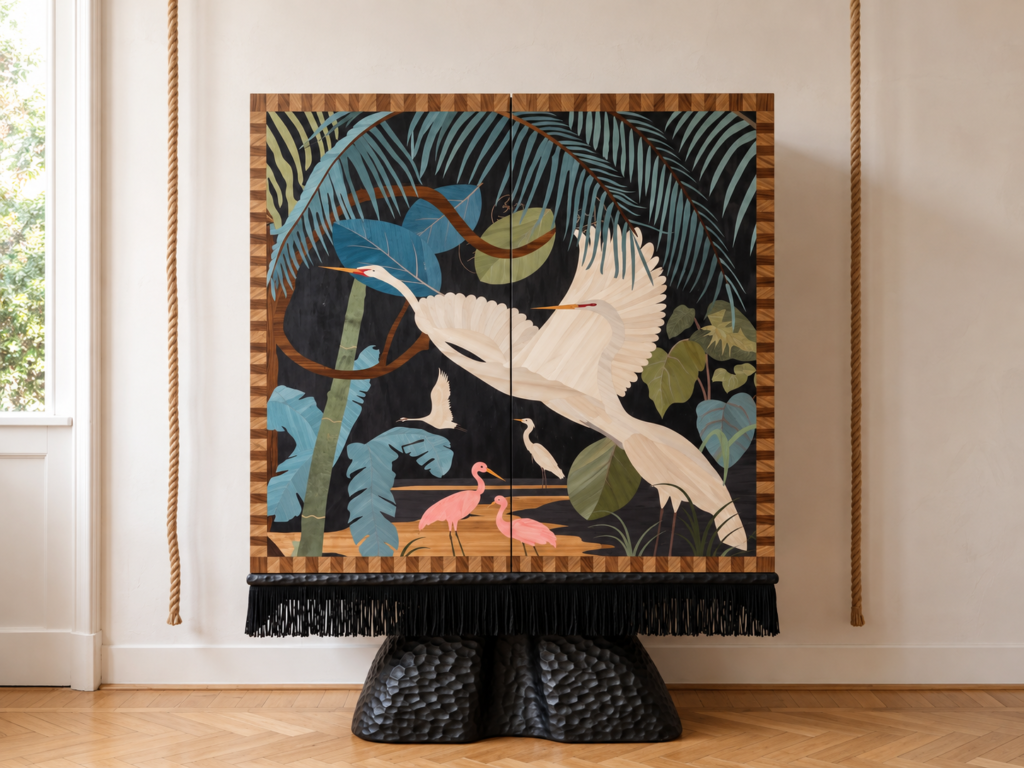
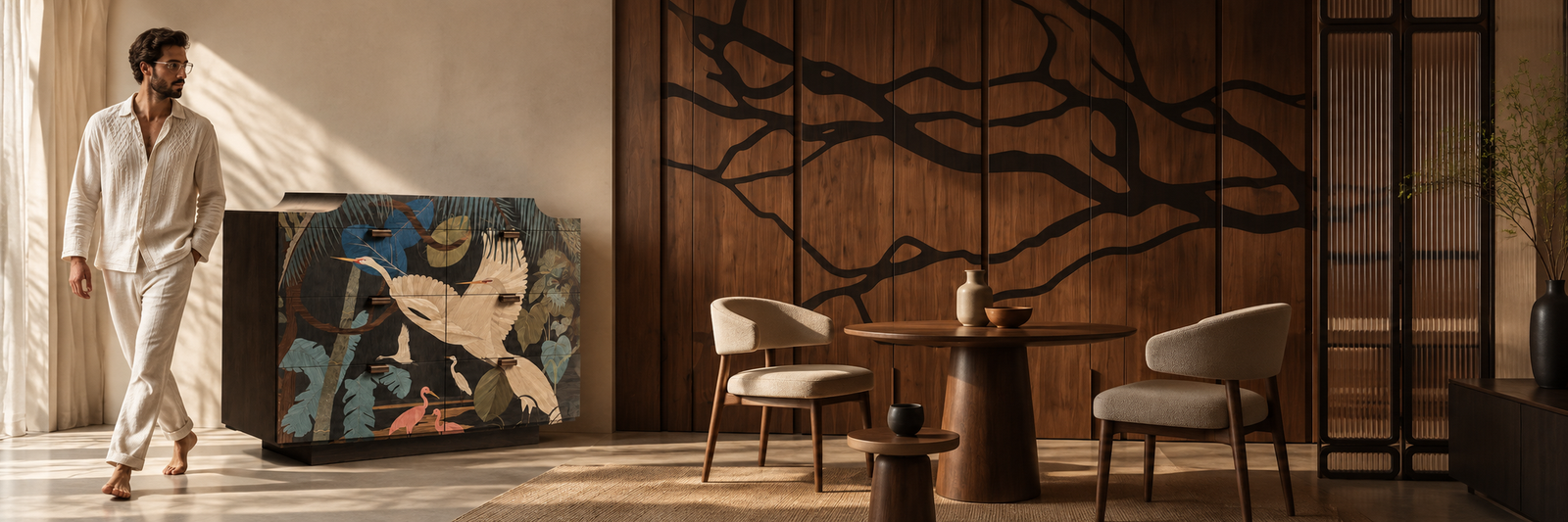
Take a piece like the Wings of Eden chest of drawers. Cranes mid-flight, tropical palms, layered foliage, and a deep, almost nocturnal background come together across a single continuous composition that spans every drawer front.
What makes this more than decorative veneer is the continuity of the scene. The image doesn’t repeat or tile – it flows, the way a mural would across a wall, except it is constructed entirely from timber. It transforms a functional storage piece into what is essentially a wearable landscape for the room.
This is the power of marquetry as a design language: it turns cabinetry and feature walls into immersive works of art, rather than background furniture.
Case Study: Wildtrace – When Simplicity Becomes the Statement
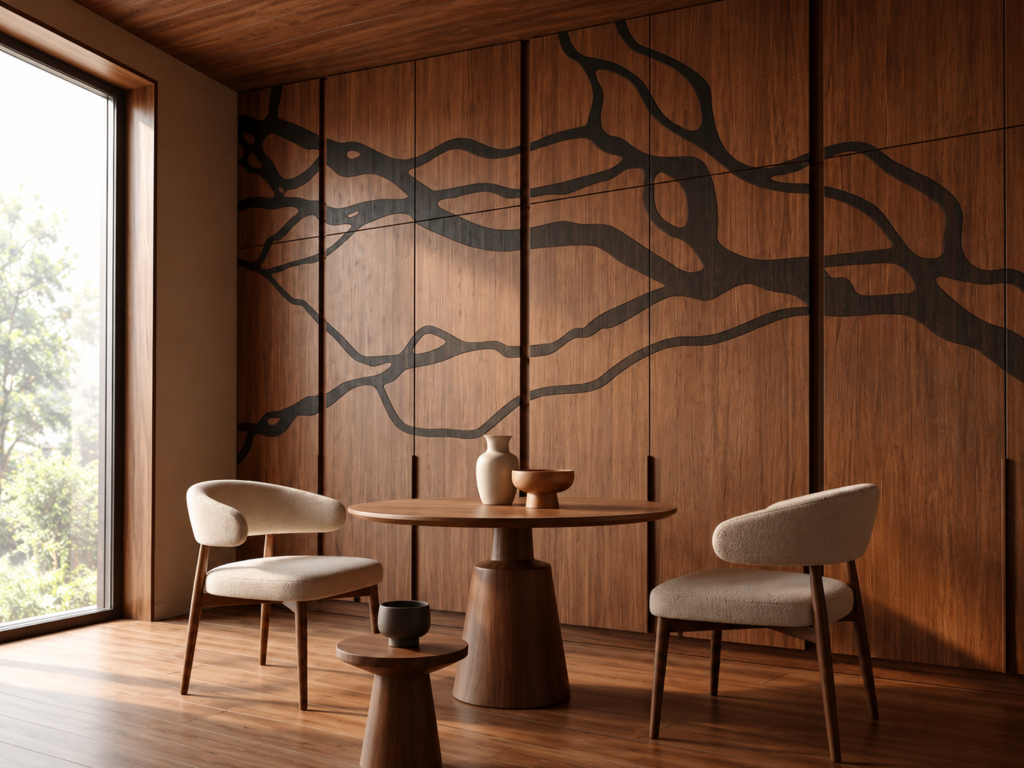
Not every space calls for a dense, storytelling composition. That’s where simple marquetry designs earn their place, and where our Wildtrace collection lives.
Wildtrace strips marquetry back to its most elemental gesture: dark, root-like inlays tracing organically across a warm walnut veneer, as though drawn by nature itself rather than a craftsman’s hand. No birds, no color palette, no literal scene, just movement and contrast.
This restraint is deliberate. Simple marquetry designs like Wildtrace prove that nature-inspired furniture doesn’t need to be maximalist to be striking. A single motif, repeated with subtle variation across paneling, can carry an entire room, ideal for spaces like boardrooms, hospitality lobbies, or feature walls where a bolder scene might overwhelm.
Where Marquetry Works Best in Modern Interiors
- Feature walls – a single marquetry panel can anchor an entire room without additional artwork
- Case goods – chests, sideboards, and wardrobes become sculptural rather than purely functional
- Hospitality and commercial spaces – lobbies, restaurants, and boutique hotels use marquetry to create a signature, photograph-worthy moment
- Headboards and bedroom furniture – nature motifs bring a sense of calm appropriate to rest spaces
Choosing Between Bold and Simple Marquetry Designs
If you’re specifying marquetry for a project, the decision usually comes down to one question: should this piece be the room’s focal point, or should it support a story that’s already being told elsewhere?
Choose a scenic, detailed composition (like Wings of Eden) when the piece is meant to be the statement – a single wall or hero furniture item with nothing competing for attention.
Choose a simple, linear marquetry design (like Wildtrace) when you want texture and organic energy without pulling focus from architecture, lighting, or other design elements already at play.
Both approaches share the same DNA: wood, worked by hand, shaped by nature.
The Bigger Shift
Marquetry’s return isn’t nostalgia – it’s a response to how people want to live now. As mass production makes everything feel replaceable, nature-inspired furniture built through genuine craftsmanship offers something spreadsheets and algorithms can’t manufacture: a sense of place, story, and permanence.
At Flava, that’s the entire premise behind our marquetry veneers, proof that a wall or a cabinet can be engineered with precision and still feel like it grew there.